

 Apr 13, 2026
Everyone talks about how amazing the wedding ceremonies are. From mehendi to phere, the family plans every moment to the T. But no one talks about what happens after your vows. The couple is now officially married, but that’s not the end of the rituals. Indian weddings have a lot of pre-wedding rituals, and even more elaborate are the post-wedding rituals. They’re unique to every culture. Post wedding rituals act like a cooldown after a chaotic wedding. They’re intimate rituals with only close family. This period acts as a smooth transition for the newlyweds into their life together.
But if you thought that these were to being much after the wedding, then you’re mistaken. Turns out it starts the minute you leave the wedding venue.
The Vidaai
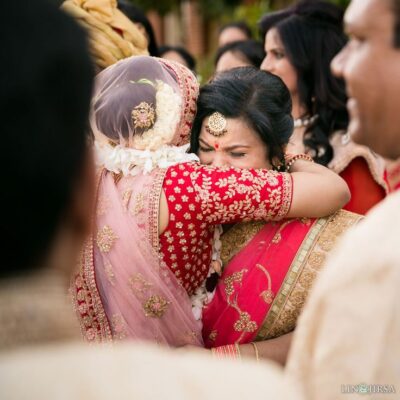
You must have seen countless weddings; everyone is happy throughout, but there’s one moment where you see tears. Vidaai is that bittersweet moment for the bride’s family. One part is happy that she’ll be starting a family. While the other is sad that she’ll be leaving her own family.
What gets me the most every time is the stillness of the bride in those moments of chaos. The families are preparing to leave, friends are exhausted from the wedding chaos. The cameras flashing everywhere, trying to capture every moment of Vidaai. And then there’s the bride standing in stillness. She’s probably thinking about all the struggles that finally brought her to this moment of her dream wedding. The thoughts of how she might cope in the new settings of her marital home. In those moments, she’s feeling a mix of emotions that can’t be put into words.
Somehow all of that feels okay because family and friends are there with you. Friends hold on a little longer than usual because a hug says it all. Parents try their best to keep it together. Most of them don’t quite manage it.
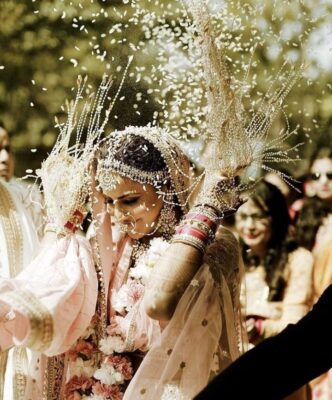
In some cultures, the bride throws rice (chawal) over her head while leaving, signifying that while the Grihlakshmi might be leaving, her blessings stay in her maternal home as well in the form of rice that represents abundance and prosperity. When your vidaai happens, allow it to move you. Stay raw instead of holding back for the lens. These seconds matter most when lived fully, not staged neatly. Memory beats pictures every time.
Griha Pravesh
This is one of the post wedding rituals that feels quite the opposite of the anxiety of vidaai, as it’s your first step in your new home as a couple. It’s filled with the excitement of new beginnings, and just as you bid farewell to one house with rice over your head, you enter this new house by gently kicking a Kalash full of rice, bringing abundance and prosperity as the Lakshmi of this new house.
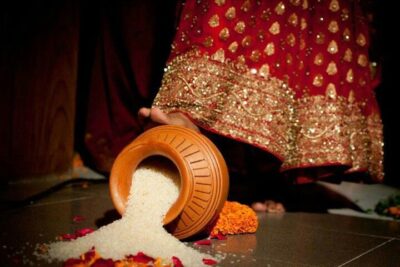
Walking into your new home is another mix of emotions a bride feels. You walk into the new house as you wonder about how life’s going to change. The day-to-day happening will be different. How will you adapt to the new settings? Will your new family give you the same warmth and comfort? All these questions flood a new bride’s mind, but the joy of starting a new life trumps all of that.
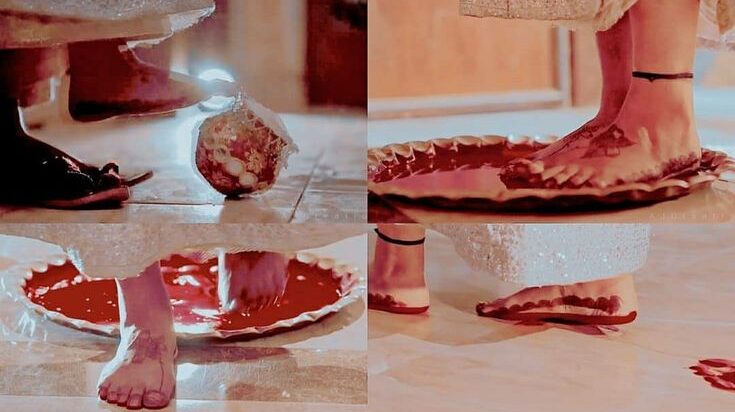
As the Lakshmi of the house, the bride also receives a lot of gifts to honor her presence and the blessings that come along. It might be overwhelming at first, but as the rituals go on, the transition becomes easier. The newness fades gently with these rituals
First Impressions and New Dynamics
Mooh Dikhai: Getting to Know Everyone
The string of rituals continues one after another. As the new bride settles in the house, the grooms family is excited to meet the bride too. Family and friends who couldn’t make it to the wedding visit the new couple. Even the ones that made it to the wedding but couldn’t have a chat during the chaos are now visiting .
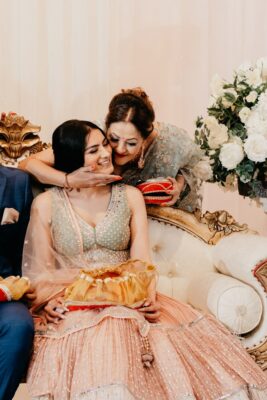
In some cultures, Mooh Dikhai starts with the mother-in-law seeing her daughter-in-law through a mirror.The family follows with sweets and gifts for her. After that the rest of the family interacts with the bride. Showering with gifts, sweets, and blessings, the family makes her feel included by sharing old stories and family traditions.
Peheli Rasoi: The sweet start to a new chapter
Pehli rasoi is one of those rituals that sounds simple on paper but feels significant when you’re actually in it. The bride cooks her first meal in her new home, usually something sweet like halwa or kheer, and the family gathers to share it.
It was never about the cooking skills but giving the bride her little space to figure out. The feeling of something warm and sweet coming to the table from the new bride. For the family its excitement of new tastes, and for the bride its more like a treasure hunt to find things in the kitchen.
Breaking the Ice With Post Wedding Rituals
Chaos finds its way through every wedding ritual in India. One of such rituals is Ring-In-Bowl. Here, a big bowl is filled with water, some milk, flower petals, and a wedding ring. The task for the bride and groom is to find the ring from this mixture. It’s a head-on competition, whoever finds the ring first wins. To add to the competitive spirits, some cultures add an advantage for the winner. It is that the winner will have an upper hand in the marriage.
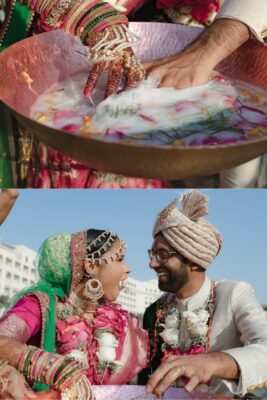
As ridiculously silly as it sounds, that is the whole point. Before real talk begins, silly moments take over instead. Winning something, like pulling a ring from sloshing water, makes stiffness vanish fast. Awkwardness? Nearly impossible after that.
Chooda Removal and Staynarayan Pooja
Chooda removal is one of the last rituals. Sometimes it’s kept on for a month after the wedding, or even for a year. It is one of those very intimate rituals carried out only with family members. Its done once the newness of the wedding is gone and the bride is all setteled in her new home.
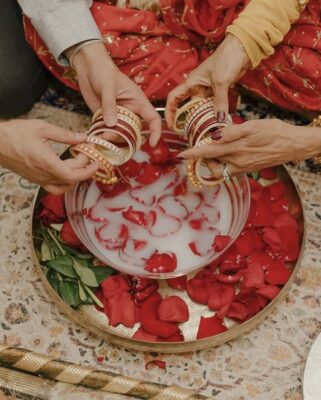
To pray for the peace and prosperity of the house, people carry out the Satyanarayan Pooja. It is the only ritual where you find peace and stillness. After weeks of sleepless nights and unmatched chaos, it’s this ritual where you can finally feel the divinity.
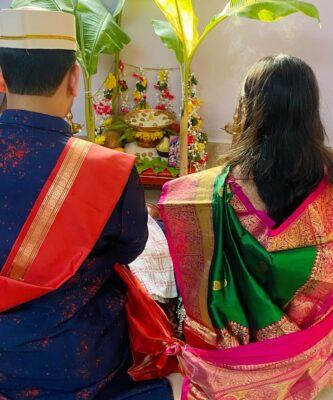
Families describe it less as a ritual and more as a moment to breathe. A chance to feel grateful before regular life begins. For a lot of couples it ends up being one of the memories that stays longest, not because anything dramatic happened, but because it was the first time the whole thing felt real and calm at the same time.
Didn’t you feel the transition?
You might wonder what even changes by the end of these rituals. But that’s the thing, these rituals make the transition so smooth that you don’t even feel the shit. One moment you’re just visiting. Then slowly, without warning, things shift, through mornings passing coffee across the table instead of formal introductions.
Don’t rush this phase. Everyone wants to fast-forward to “settled,” but the settling itself is worth paying attention to. The awkwardness, the warmth, the confusion, the laughter. All of it is the beginning of something. And beginnings, even messy ones, are worth being present for.


.jpg)